IPC/WHMA-A-620 is the industry standard for the requirements and acceptance of cable and wire harness assemblies. It gives manufacturers, engineers, inspectors, and buyers a shared way to judge workmanship quality across different reliability classes.
This guide explains what the standard covers, who uses it, how its three product classes work, what certification means, and how it relates to other IPC standards, so you can apply it confidently when sourcing or building cable and harness assemblies.
Contents
- Key Takeaways
- What is IPC/WHMA-A-620?
- Why is IPC/WHMA-A-620 Important?
- Who Uses IPC/WHMA-A-620?
- What does IPC/WHMA-A-620 Cover?
- What are IPC/WHMA-A-620 Product Classes?
- Class 1: General electronic oroducts
- Class 2: Dedicated service electronic products
- Class 3: High-performance or harsh-environment electronic products
- IPC/WHMA-A-620 Certification: What Does it Mean?
- IPC/WHMA-A-620 vs IPC-A-610
- IPC/WHMA-A-620 vs IPC J-STD-001
- IPC/WHMA-A-620 vs IPC-D-620
- Industries that Use IPC/WHMA-A-620 Cable and Wire Harness Assemblies
- Industrial automation
- Automotive and transportation
- Medical devices
- Aerospace and defense
- Communications
- Consumer electronics
- Why Work With OurPCB for Cable and Wire Harness Assembly?
- FAQs About IPC/WHMA-A-620
- Is IPC/WHMA-A-620 only for wire harnesses?
- Does IPC/WHMA-A-620 cover crimping?
- Which IPC/WHMA-A-620 revision should I specify?
- What’s the difference between IPC/WHMA-A-620 certification and IPC/WHMA-A-620 compliance?
- Does IPC/WHMA-A-620 require specific testing equipment?
Key Takeaways
- IPC/WHMA-A-620 is the main acceptance standard for cable and wire harness assemblies.
- The standard helps define workmanship quality for crimping, soldering, wire preparation, splicing, marking, routing, shielding, molding, potting, and testing.
- IPC/WHMA-A-620 uses three product classes: Class 1, Class 2, and Class 3.
- Class 3 has the strictest requirements and is used for high-performance, harsh-environment applications.
- The standard helps buyers and manufacturers align expectations before production begins.
- To use IPC/WHMA-A-620 properly, your drawings or purchase order should specify the required revision, product class, testing requirements, and documentation needs.
What is IPC/WHMA-A-620?
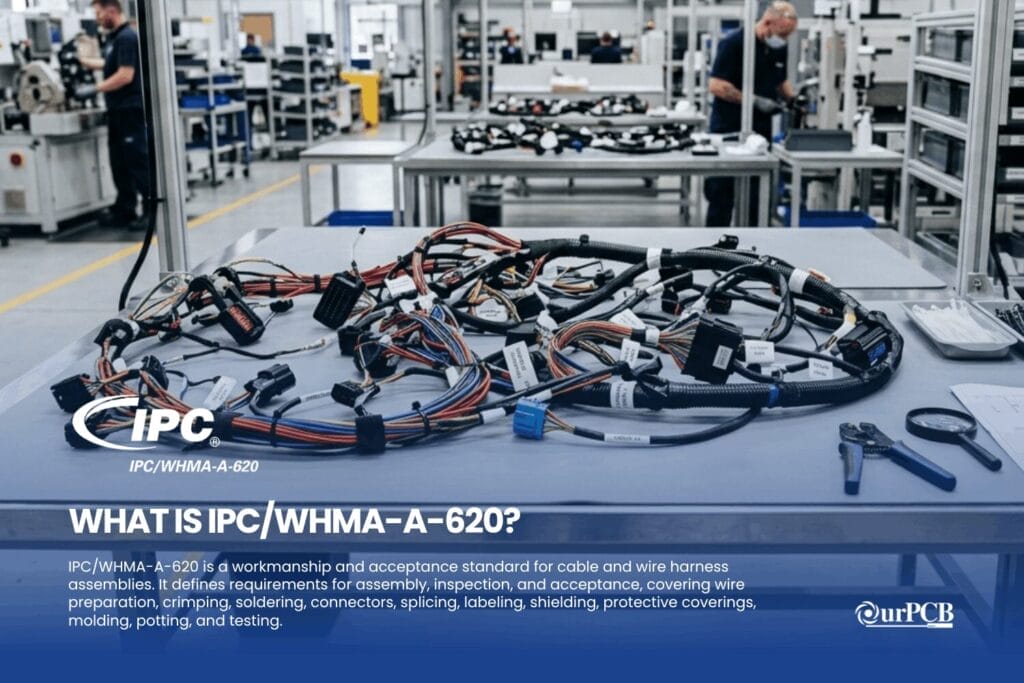
IPC/WHMA-A-620, formally known as Requirements and Acceptance for Cable and Wire Harness Assemblies, is a workmanship and acceptance standard for cable, wire, and harness assemblies.
IPC and WHMA developed it to provide consistent criteria for how cable and wire harness assemblies should be built, inspected, and accepted. The standard covers a wide range of assembly details, including wire preparation, crimping, soldering, connector installation, splicing, labeling, shielding, protective coverings, molding, potting, and testing.
In simple terms, IPC/WHMA-A-620 answers questions such as:
- Is this crimp acceptable?
- Is the insulation stripped correctly?
- Is the solder joint clean and properly formed?
- Is the connector installed correctly?
- Is the label readable and permanent enough?
- Is the harness routed and secured correctly?
- Does this assembly meet the correct reliability class?
For buyers, IPC/WHMA-A-620 provides a benchmark for supplier quality. For manufacturers, it gives production and inspection teams a shared standard to follow.
Why is IPC/WHMA-A-620 Important?
Cable and wire harness assemblies often serve as the nervous system of an electronic product. They connect power, signals, sensors, controls, displays, motors, and circuit boards. If a wire harness fails, the entire product may stop working.
IPC/WHMA-A-620 is important because it reduces ambiguity in cable assembly manufacturing. It helps customers and suppliers agree on what counts as acceptable workmanship before production begins.
Without a recognized standard, one inspector may accept a crimp while another rejects it. One supplier may consider minor insulation damage acceptable, while another may treat it as a defect. IPC/WHMA-A-620 helps remove this uncertainty by creating a common quality language.
Who Uses IPC/WHMA-A-620?
Organizations involved in designing, sourcing, manufacturing, inspecting, or integrating cable and wire harness assemblies use IPC/WHMA-A-620. This includes cable and wire harness manufacturers, PCB assembly and box-build companies, OEMs, engineers, quality teams, procurement teams, inspectors, and contract manufacturers. It also covers suppliers serving aerospace, defense, medical electronics, and industrial equipment.
The standard is especially useful for products that require consistent electrical performance, mechanical durability, traceable quality, and clearly defined inspection criteria.
What does IPC/WHMA-A-620 Cover?
IPC/WHMA-A-620 encompasses acceptance requirements for the entire range of workmanship details impacting cable and harness quality – from initial wire preparation to final testing.
| What the Standard Covers | |
|---|---|
| Wire preparation | Stripping, conductor condition & insulation handling |
| Crimp terminations | Conductor brush, bellmouth, insulation clearance, crimp deformation & terminal damage |
| Soldered terminations | Joint formation, electrical soundness & mechanical stability |
| Mechanical interconnections | Connector locks, fasteners, clips & strain relief |
| Splices | Soldered, crimped, ultrasonic, lap, hook, mesh & heat-shrink splice methods |
| Connector installation | Seating, alignment, retention & sealing |
| Molding, overmolding & potting | Strain relief, environmental protection & sealing |
| Marking & labeling | Readability, permanence & positioning |
| Securing & routing | Abrasion prevention, conductor fatigue & connector strain |
| Shielding & grounding | Braided shields, jumpers, conductive tapes, ground points & shield termination |
| Protective coverings | Abrasion, heat, chemical & moisture protection |
| Length tolerances | Acceptable variation for overall, branch & breakout lengths by product class |
| Testing | Electrical continuity, insulation resistance & class-specific requirements |
For each area, the standard defines what acceptable workmanship looks like at the chosen product class. The exact requirements your assembly must meet should be specified on the drawing or purchase order, including the standard revision, applicable class, and any customer-specific criteria.
Special Offer: Get $100 off your order!
Email [email protected] to get started!
What are IPC/WHMA-A-620 Product Classes?
IPC/WHMA-A-620 uses three product classes to help customers and manufacturers match workmanship expectations to the product’s end-use environment. The higher the class, the stricter the acceptance criteria become.
Class 1: General electronic oroducts
Class 1 applies to general electronic products where the main requirement is basic function. These products are usually lower-risk, lower-cost, or less demanding, meaning the product is expected to work, but long service life and uninterrupted operation are not the highest priorities.
Class 1 may apply to simple consumer electronics, basic appliances, low-cost electronic devices, non-critical assemblies, and products with a limited expected lifespan. It’s suitable when product failure does not create major safety, financial, or operational consequences.
Class 2: Dedicated service electronic products
Class 2 applies to products where continued performance and extended service life are important. These products should operate reliably over time, although uninterrupted service is usually desired rather than absolutely critical.
Class 2 is often used for industrial equipment, communication devices, commercial electronics, control systems, business equipment, test equipment, and some automotive-adjacent electronics, depending on the application. It’s one of the most common choices for commercial and industrial cable assemblies because it provides stronger reliability expectations than Class 1 without requiring the strictest standards of Class 3.
Class 3: High-performance or harsh-environment electronic products
Class 3 applies to products where performance is critical, downtime cannot be tolerated, or the end-use environment may be harsh. This is the strictest IPC/WHMA-A-620 class.
Class 3 may apply to aerospace and defense electronics, medical devices, life-support equipment, harsh industrial systems, transportation electronics, and safety-critical communication or power control systems. For Class 3 assemblies, workmanship must support high reliability. This affects requirements for terminations, insulation clearance, routing, strain relief, soldering, crimping, shielding, cleanliness, and testing.
IPC/WHMA-A-620 Certification: What Does it Mean?
IPC/WHMA-A-620 certification shows that individuals have been trained to understand and apply the standard. It’s commonly used for operators, inspectors, trainers, engineers, and quality personnel involved in cable and harness assembly work.
However, “IPC certified” can mean different things depending on the context. It may refer to trained individuals, internal company procedures, or broader supplier qualification programs.
Common IPC training roles include:
- Certified IPC Specialist
- Certified IPC Trainer
- Certified Standards Expert
For buyers, it’s important to ask the supplier exactly what they mean when they say they build to IPC/WHMA-A-620.
Useful questions include:
- Which team members are trained or certified?
- Which revision of IPC/WHMA-A-620 do you use?
- Which product classes can you support?
- How do you inspect and document workmanship?
- What test records can you provide?
- How do you handle nonconforming assemblies?
- Are your crimping tools calibrated?
- How do you control soldering quality?
- How do you verify wire pull strength?
- How do you document rework or repair?
Certification is helpful, but it should be supported by strong process control, inspection systems, documentation, and manufacturing experience.
IPC/WHMA-A-620 vs IPC-A-610
IPC/WHMA-A-620 and IPC-A-610 are both important electronics acceptance standards, but they apply to different assemblies.
IPC/WHMA-A-620 applies to cable, wire, and harness assemblies.
IPC-A-610 applies to electronic assemblies, especially printed circuit board assemblies.
A product may need both. For example, a control unit may include a PCB assembly built to IPC-A-610 and cable harnesses built to IPC/WHMA-A-620. When these parts are integrated into a complete product, both standards can support consistent workmanship quality.
IPC/WHMA-A-620 vs IPC J-STD-001
IPC J-STD-001 focuses on soldered electrical and electronic assemblies. It’s often used for soldering process requirements.
IPC/WHMA-A-620 focuses on the acceptability of cable and wire harness assembly acceptability.
The two standards can overlap when a wire harness includes soldered terminations. In that case, the customer may specify both standards or define which one controls specific workmanship requirements.
IPC/WHMA-A-620 vs IPC-D-620
IPC-D-620 is related to cable and wire harness design.
IPC/WHMA-A-620 is mainly focused on acceptance requirements for completed cable and wire harness assemblies.
In practical terms:
- Use IPC-D-620 to support design and process requirements.
- Use IPC/WHMA-A-620 to evaluate workmanship acceptability.
For best results, design teams and manufacturing teams should align early so the harness can be built, inspected, tested, and documented without unnecessary delays.
Industries that Use IPC/WHMA-A-620 Cable and Wire Harness Assemblies
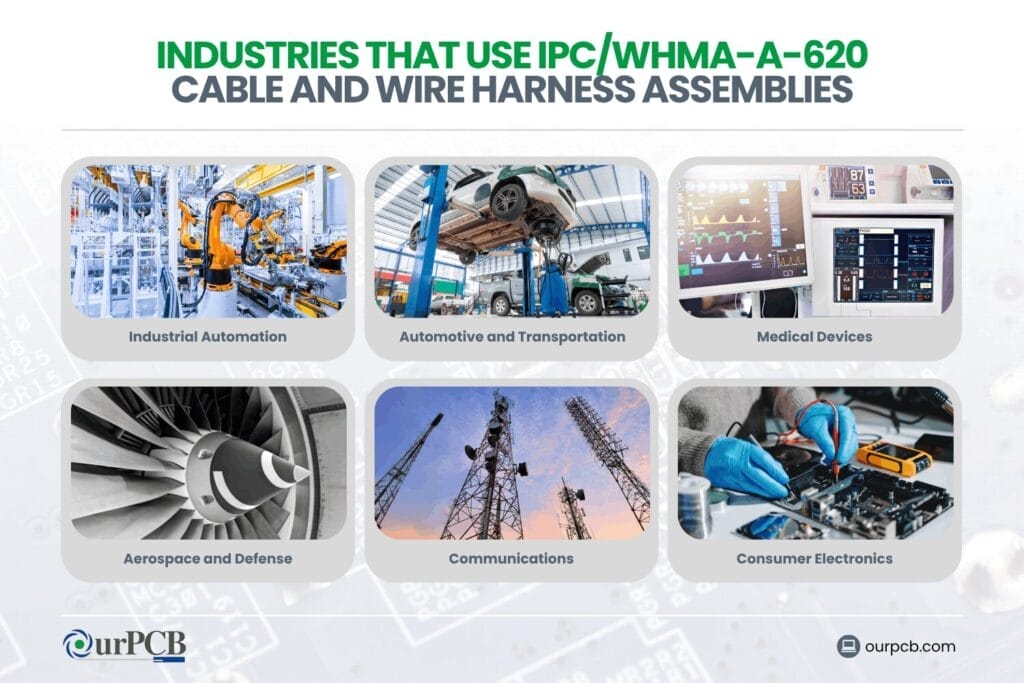
IPC/WHMA-A-620 is used across many industries where reliable electronic interconnections matter.
Industrial automation
Industrial equipment often depends on cable assemblies for sensors, controllers, motors, switches, power distribution, and communication lines. Assemblies may be exposed to vibration, electrical noise, heat, oil, and repeated machine movement.
Automotive and transportation
Vehicles and transportation systems use wire harnesses for power, control, lighting, sensors, communication, and safety systems. These assemblies must often withstand vibration, temperature changes, moisture, and long service life requirements.
Medical devices
Medical electronics require dependable connections because product failure can affect patient care, diagnostics, monitoring, or treatment. Cable assemblies may also need biocompatible materials, sterilization compatibility, or strict traceability depending on the product.
Aerospace and defense
Aerospace and defense applications often require Class 3 workmanship because failure can affect safety, mission success, and system reliability. These assemblies may face shock, vibration, pressure changes, EMI, and extreme temperatures.
Communications
Communication systems rely on clean signal transmission. Coaxial, biaxial, shielded, and high-speed cable assemblies require careful handling to maintain signal integrity.
Consumer electronics
Even lower-risk consumer electronics benefit from consistent workmanship, especially when products are manufactured at scale and need predictable performance.
Why Work With OurPCB for Cable and Wire Harness Assembly?
PC/WHMA-A-620 sets the bar, but meeting it consistently depends on the manufacturer behind the assembly. The right supplier should give you clarity on product class, traceability on workmanship, and documentation you can hand to your quality team without follow-up questions.
That's where OurPCB comes in. With over 15 years of experience and 2,500+ global customers including ABB and Intel, we manufacture cable assemblies, wire harnesses, PCB assemblies, and full box-build products from our ISO 9001-certified factories in Shijiazhuang and Shenzhen. Our process is built around IPC-Class 3 PCB assembly with full traceability, authorized component sourcing from suppliers like Arrow and Avnet, and lead times as fast as 24 to 48 hours for rapid prototypes.
When you work with us, you get one team handling PCB manufacturing, cable assembly, harness production, component procurement, and testing – which means fewer documentation gaps between your boards, harnesses, and finished product. You'll work with engineers who can review your drawings, confirm the right product class for your application, recommend materials, and flag manufacturability issues before they cost you time in production.
Contact OurPCB today for a custom quote on your IPC/WHMA-A-620 cable assembly or wire harness project. Send us your drawings, BOM, connector requirements, and target product class, and we'll come back with a build plan that supports reliable performance from prototype through volume production.
FAQs About IPC/WHMA-A-620
Is IPC/WHMA-A-620 only for wire harnesses?
No. IPC/WHMA-A-620 applies to cable assemblies, wire harness assemblies, and related interconnection work. It can be used for simple wire leads, complex harnesses, coaxial assemblies, shielded cables, and multi-branch cable assemblies.
Does IPC/WHMA-A-620 cover crimping?
Yes. IPC/WHMA-A-620 includes requirements for crimped terminations, including open-barrel contacts, closed-barrel contacts, machined contacts, ferrules, terminals, insulation support, conductor placement, and related acceptance conditions.
Which IPC/WHMA-A-620 revision should I specify?
The current revision is the one to specify by default, but legacy products, military programs, or long-running customer specifications may require an earlier revision. The drawing or purchase order should call out the exact revision used for inspection. For example, “IPC/WHMA-A-620 Revision E, Class 2”, so the manufacturer and inspector apply the same criteria. If you’re unsure which revision applies to your program, confirm with your supplier before production begins.
What’s the difference between IPC/WHMA-A-620 certification and IPC/WHMA-A-620 compliance?
Certification refers to trained individuals, such as Certified IPC Specialists, Trainers, or Standards Experts, who’ve passed IPC’s formal training program. Compliance refers to whether an assembly meets the standard’s acceptance criteria, regardless of who built it. A supplier can build to IPC/WHMA-A-620 without having certified staff, and certified staff don’t automatically guarantee every assembly is compliant. Buyers should ask for both: trained personnel and documented inspection evidence showing the finished assembly meets the specified class.
Does IPC/WHMA-A-620 require specific testing equipment?
The standard defines what acceptable workmanship looks like, but it doesn’t mandate specific brands or models of test equipment. It does require that crimp tools are calibrated, that pull-test and continuity-test methods follow recognized procedures, and that inspection magnification matches the class requirements. For Class 3 work, traceable calibration records and documented test methods are usually expected. Suppliers should be able to show their calibration schedule, test procedures, and inspection equipment list on request.
Back to Top: What Is IPC/WHMA-A-620? Cable and Wire Harness Assembly Standard Explained
Special Offer: Get $100 off your order!
Email [email protected] to get started!