Underwriters Laboratories (UL) help engineers, buyers, and manufacturers choose wire and cable that can safely perform in specific electrical, mechanical, and environmental settings. These standards matter because the wrong wire can lead to overheating, insulation failure, failed inspections, delayed production, or unsafe finished products.
This guide covers what UL wire standards are, how UL Listed differs from UL Recognized, the most common UL standards and style numbers, key specifications to review, and what wire designation letters mean, so you can match the right wire to your application with confidence.
Contents
- Key Takeaways
- What are UL Wire Standards?
- Why UL Wire Standards Matter
- UL Listed vs UL Recognized vs UL Certified Wire
- Common UL Wire Standards and What they Cover
- UL Standards Worth Knowing in More Detail
- UL 758: Appliance Wiring Material (AWM)
- UL 1277: Tray Cable
- UL 13: Power-Limited Circuit Cable
- Common Industrial and Commercial UL Wire Styles
- Important UL Wire Specifications
- 1. Voltage rating
- 2. Temperature rating
- 3. AWG size and current capacity
- 4. Insulation material
- 6. Jacket material
- 7. Flame test requirements
- 8. Special environmental ratings
- Common wire designation letters
- Need Help Choosing UL Wire for Your Assembly?
- FAQs About UL Wire Standards
- Can UL AWM wire be used for building wiring?
- What does VW-1 mean on a wire?
- What does sunlight resistant mean on cable?
- What is the best UL wire for a custom cable assembly?
- How do I read a UL wire marking?
- What's the difference between UL Style 1007 and UL Style 1015?
Key Takeaways
- UL wire standards help define the safety, construction, testing, marking, voltage, temperature, and flame-performance requirements for wire and cable.
- There is no single 'UL wire standard'; the correct standard depends on whether the wire is used inside equipment, in buildings, in machinery, in trays, or in communications systems.
- UL 758 is one of the most common standards for Appliance Wiring Material, also known as AWM, which is widely used inside appliances, control panels, electronic equipment, and wire harness assemblies.
- UL Listed, UL Recognized, UL Certified, and UL Verified do not mean the same thing, so buyers should check the actual UL marking and product category.
- Important wire specifications include voltage rating, temperature rating, AWG size, insulation material, flame test, jacket material, oil resistance, sunlight resistance, and wet-location suitability.
- Surface printing on wire is useful, but the full UL mark, product label, packaging, file number, and datasheet should also be reviewed before production.
What are UL Wire Standards?
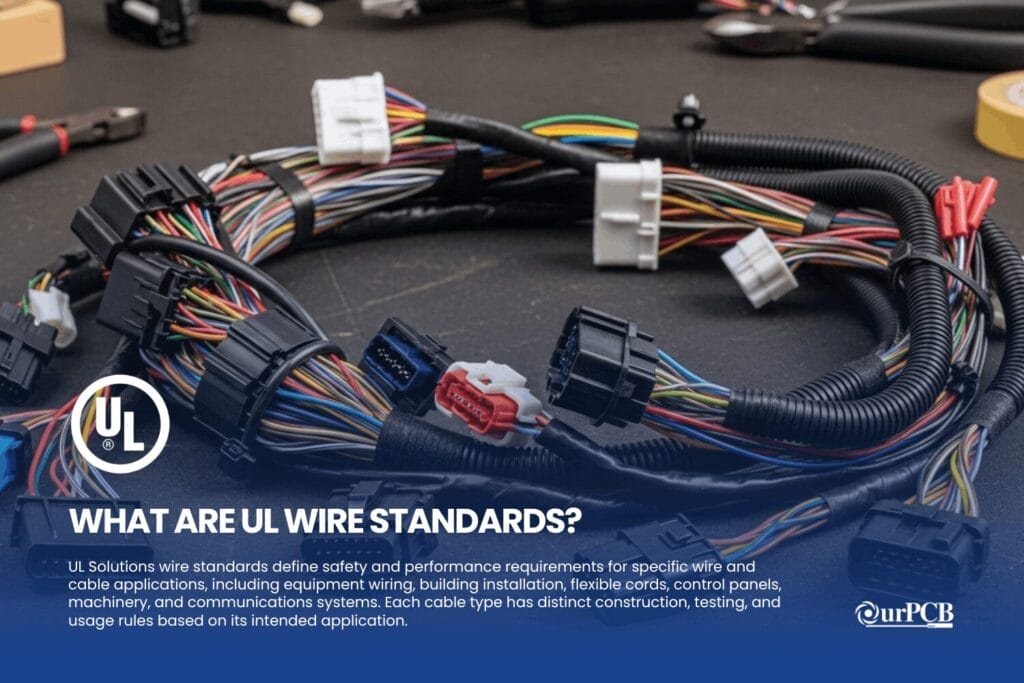
UL wire standards are safety and performance requirements used to evaluate wire and cable products. They help confirm whether a wire or cable construction is suitable for a specific use, such as internal equipment wiring, building installation, flexible cord applications, control panels, industrial machinery, or communications systems.
For example, a UL AWM wire used inside an appliance is not automatically suitable for building wiring. A tray cable is not the same as a flexible cord. A communication cable is not the same as a power cable. Each product type has its own rules.
Why UL Wire Standards Matter
UL wire standards matter because wire and cable are often exposed to heat, current, movement, chemicals, moisture, vibration, abrasion, and flame risk. If the wire does not match the application, the insulation can crack, melt, burn, absorb moisture, or fail electrically.
For manufacturers, using the correct UL wire can help improve product safety, reduce redesign risk, support regulatory review, and build customer confidence. It can also reduce failed inspections, prevent incompatible material substitutions, and support repeatable production. Beyond that, it helps match customer drawings and bill of materials (BOM) requirements and improves traceability in wire harness and cable assembly production.
For printed circuit board (PCB) and cable assembly projects, wire selection is not only a purchasing decision. It affects product reliability, enclosure design, connector choice, current capacity, routing, bend radius, temperature rise, and long-term performance.
UL Listed vs UL Recognized vs UL Certified Wire
UL terms can be confusing, especially when suppliers use phrases like 'UL approved' or 'UL rated' without explaining what they mean. In formal procurement and engineering documentation, it’s better to use the exact UL status shown on the product record.
| Category | What It Means | Common Examples or Uses |
|---|---|---|
| UL Listed Wire | Wire or cable evaluated as a finished product for a specific use. Its construction, markings, & intended application are assessed under the relevant UL standard. | Building wires, flexible cords, communication cables, tray cables, & power-limited cables. |
| UL Recognized Component Wire | Wire evaluated as a component used inside a larger finished product. | Appliance Wiring Material, or AWM, used in internal equipment wiring, appliance wiring, electronic assemblies, & wire harnesses. |
| UL Certified Wire | A broader term indicating that a product has been evaluated & certified under the relevant UL requirements. | May appear in modern UL programs & documentation for different wire & cable products. |
| UL Verified Wire or Cable | Wire or cable evaluated for specific performance claims rather than only safety construction. | Data, telecom, structured cabling, & communication cables. |
Special Offer: Get $100 off your order!
Email [email protected] to get started!
Common UL Wire Standards and What they Cover
Different UL standards apply to different wire and cable types. Below are some of the most important standards engineers and buyers may encounter.
| UL Standard | Main Product Type | Common Applications |
|---|---|---|
| UL 758 | Appliance Wiring Material, or AWM | Internal wiring, appliances, electronic equipment, control panels, wire harnesses |
| UL 83 | Thermoplastic-insulated wire | Building wire, conduit wiring, feeders, branch circuits |
| UL 44 | Thermoset-insulated wire | Industrial wiring, building wire, high-performance insulation applications |
| UL 1063 | Machine tool wire (MTW) | Industrial machinery, control cabinets, equipment wiring |
| UL 62 | Flexible cords & cables | Portable equipment, appliances, cord sets, flexible power connections |
| UL 1277 | Tray cable | Power & control cable in cable trays & raceways |
| UL 13 | Power-limited circuit cable | CL2, CL3, PLTC, low-voltage control & signal circuits |
| UL 444 | Communications cable | Voice, data, audio, telecom, & network cable |
| UL 1581 | Reference standard | General wire & cable construction & test requirements |
| UL 2556 | Test methods | Wire & cable testing methods & calculations |
| UL 1685 | Flame & smoke testing | Vertical tray flame & smoke testing for certain cable types |
UL Standards Worth Knowing in More Detail
UL 758: Appliance Wiring Material (AWM)
UL 758 is the most relevant UL wire standard for OurPCB customers building cable assemblies, wire harnesses, and electronic equipment. It covers Appliance Wiring Material (AWM), where wire is intended for use as internal component wiring inside a larger finished product rather than as standalone building wire.
AWM wire is evaluated as a UL Recognized Component, which means it's approved for use inside equipment that will be tested as a complete system. This makes UL 758 the standard you'll see referenced most often on hook-up wire datasheets (UL 1007, UL 1015, UL 1061, UL 1569, UL 3173, and many others are AWM styles covered under UL 758).
Each AWM style has its own assigned number, voltage rating, temperature rating, insulation type, and intended use. Two wires with the same UL 758 listing but different style numbers may behave differently, so the style number matters as much as the standard itself.
For wire harness manufacturers, the most relevant UL wire harness standard is usually UL 758, since it governs the AWM hook-up wire used in nearly all internal equipment harness work.
UL 1277: Tray Cable
UL 1277 covers power and control tray cables. Tray cables run in industrial facilities, control systems, raceways, cable trays, and certain outdoor supported installations.
Tray cables may include:
- Power conductors
- Control conductors
- Grounding conductors
- Shielded conductors
- Thermocouple extension wires
- Optical-fiber members in some constructions
Tray cable markings may identify ratings such as:
- TC
- TC-ER
- Direct burial
- Sunlight resistance
- Oil resistance
- Wet-location rating
- Temperature rating
TC-ER marking is especially important when cable needs to run exposed between a tray and equipment, subject to specific installation conditions.
UL 13: Power-Limited Circuit Cable
UL 13 covers power-limited circuit cables, including CL2, CL3, CL2P, CL3P, CL2R, CL3R, CL2X, CL3X, and PLTC cable types.
These cables typically run low-voltage and signal applications, including control circuits, alarm systems, audio systems, building automation, and industrial control wiring.
The marking matters because plenum, riser, general-purpose, and limited-use cables aren't interchangeable. The suffix tells you where the cable can be installed:
- CL2P / CL3P: plenum spaces
- CL2R / CL3R: riser applications
- CL2 / CL3: general-purpose installations
- CL2X / CL3X: limited-use applications
Common Industrial and Commercial UL Wire Styles
The exact UL style needed depends on your product, but the following examples are commonly seen in industrial & electronic applications.
| UL Style | Type | Typical Rating | Common Use |
|---|---|---|---|
| UL 1007 | Hook-up wire | 300 V, 80°C | Internal wiring in panels, motors, transformers, & circuits |
| UL 1015 | Hook-up wire | 600 V, often 80–105°C | Internal wiring in control panels, meters, motors, & transformers |
| UL 1061 | Hook-up wire | 300 V, 80°C | Internal chassis wiring & protected equipment wiring |
| UL 1569 | Hook-up wire | 300 V, 110°C | Internal wiring in household & electronic appliances |
| UL 2464 | Multiconductor cable | 300 V, 80°C | Control cable, signal cable, measurement equipment, HVAC, production equipment |
| UL 2919 | Multiconductor cable | 300 V, 80°C | Computer, data, & communication connections |
| UL 3173 | Hook-up wire | 600 V, 125°C | Control panels, transformers, coils, motors, & appliance wiring |
| UL 4511 | Silicone multiconductor cable | 600 V, high-temperature use | Heating systems, factory equipment, lighting, & high-temperature environments |
| UL 4535 | Shielded silicone multiconductor cable | 600 V, high-temperature use | Similar to UL 4511, with shielding for signal protection |
These examples are useful starting points, but they should not replace a complete engineering review. A wire style that works for one product may not work for another if the temperature, enclosure, voltage, current, motion, or environmental exposure changes.
Important UL Wire Specifications
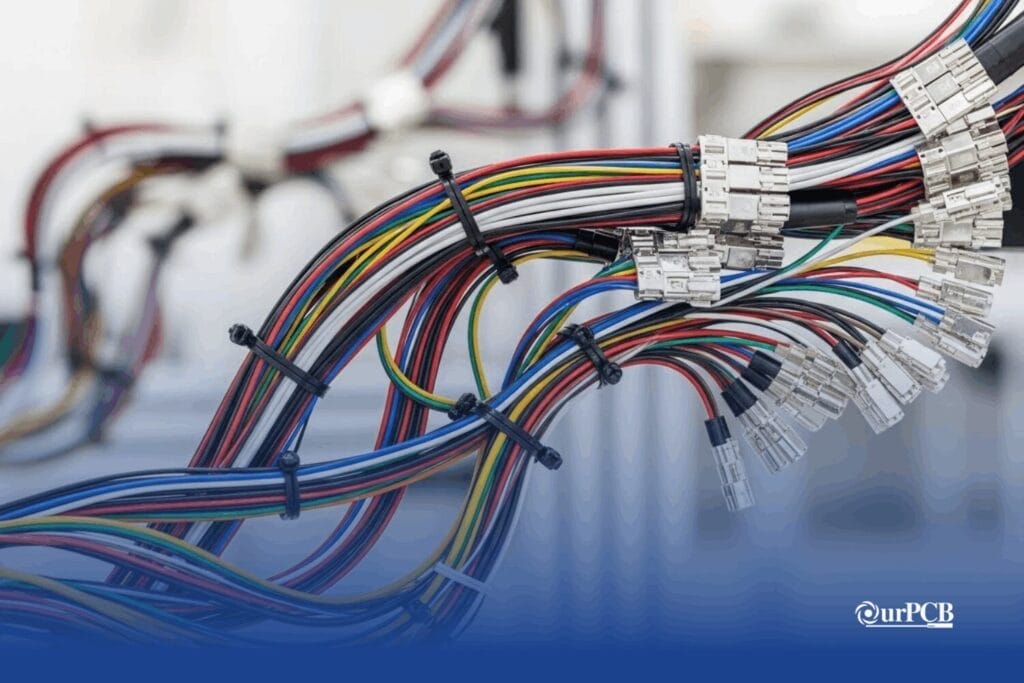
When choosing UL wire, engineers and buyers should review more than the style number. The most important specifications include voltage, temperature, conductor size, insulation, jacket, flame test, and special environmental ratings.
1. Voltage rating
The voltage rating tells you the maximum voltage the wire insulation system withstands under specified conditions. It does not tell you how much current the wire can carry. Current capacity depends on conductor size, material, temperature, installation method, bundling, and other design factors.
Common voltage ratings include:
- 30 V
- 300 V
- 600 V
- 1000 V
- 2000 V
- Higher ratings for specialized power cables
A 300 V wire may be suitable for low-voltage internal wiring, while a 600 V wire may be required for control panels, motors, transformers, or industrial equipment. Higher voltage cables may be needed for photovoltaic systems, medium-voltage power, or specialized applications.
Choosing the wrong voltage rating can lead to insulation stress, breakdown, arcing, and safety hazards.
2. Temperature rating
The temperature rating indicates the maximum operating temperature the wire insulation can tolerate without premature degradation. Some wires have one rating for dry locations and another rating for wet locations.
The temperature rating depends heavily on the insulation material. PVC, cross-linked polyethylene (XLPE), silicone, thermoplastic elastomer (TPE), fluoropolymer, and thermoset compounds each behave differently under heat.
Higher temperature ratings can improve durability, but they are not always necessary. Using a 200°C wire in a product that only reaches 50°C may add cost without improving practical performance. Using a low-temperature wire near motors, heaters, transformers, LEDs, power electronics, or enclosed power supplies can create serious reliability problems.
3. AWG size and current capacity
AWG stands for American Wire Gauge. It describes the conductor size. Smaller AWG numbers represent larger conductors, while larger AWG numbers represent smaller conductors.
For example:
- 30 AWG is very small
- 22 AWG is common for signal wiring
- 18 AWG is common for control and low-power applications
- 12 AWG is much larger and used for higher current applications
AWG choice affects electrical performance (current-carrying capacity, voltage drop, heat rise), mechanical fit (flexibility, connector compatibility, crimp quality, harness diameter), and project economics (cost and weight).
In custom wire harness design, AWG selection must match the electrical load, connector terminal, crimp tooling, routing space, and mechanical stress.
4. Insulation material
Insulation protects the conductor and helps prevent electrical shorts, shock, and signal problems. The insulation material also determines how well the wire handles heat, moisture, oil, chemicals, flame, abrasion, and flexing.
PVC is common and cost-effective for many electronic and appliance wiring applications. XLPE offers improved heat and electrical properties. Silicone is useful for high-temperature flexibility. Fluoropolymers can provide excellent chemical, temperature, and dielectric performance.
Insulation thickness also matters: thicker insulation improves dielectric strength and mechanical protection but adds size and stiffness The best insulation depends on the application, not just the UL style.
6. Jacket material
A jacket is an outer protective layer used on many multiconductor cables. It protects the internal conductors from mechanical damage, oil, moisture, sunlight, flame, A cable used inside a sealed enclosure may not need the same jacket protection as a cable installed near machinery, sunlight, vibration, or chemical exposure.
7. Flame test requirements
Wire and cable can contribute to fire spread if the insulation or jacket burns easily. UL standards often include flame testing to evaluate how wire behaves when exposed to fire.
Different installations require different flame ratings. A cable in an air-handling plenum has different requirements than a wire inside a protected electronic enclosure.
8. Special environmental ratings
Some applications require special ratings beyond basic voltage and temperature.
Common special criteria include:
- Outdoor exposure: sunlight resistance, UV resistance, and wet-location rating
- Fluid resistance: oil resistance, gasoline resistance, and chemical resistance
- Installation environment: direct burial, cable tray use, and submersible pump applications
- Fire and smoke performance: low-smoke output and halogen-free material
- Mechanical and material control: abrasion resistance and RoHS-related material control
These ratings are essential when wires or cables are exposed to industrial oils, coolants, moisture, sunlight, soil, vibration, or moving equipment.
Common wire designation letters
Building wire and flexible cord markings use letter codes that identify insulation type, temperature, and environmental ratings. For example, THHN (thermoplastic high-heat-resistant, nylon jacket), THWN (thermoplastic heat- and water-resistant), and SOOW (extra-hard usage flexible cord, oil-resistant insulation and jacket, wet-location suitable). The full letter system is published by NEC and UL standards, and your wire datasheet will spell out the exact construction behind each code.
Need Help Choosing UL Wire for Your Assembly?
Choosing the right UL wire standard can be difficult because the correct answer depends on the application, not just the wire name. AWM, MTW, THHN, tray cable, flexible cord, and communications cable all serve different purposes.
At OurPCB, we help customers source and build PCB assemblies, cable assemblies, wire harnesses, and box-build products that match the electrical and compliance needs of the final application. If your project requires UL-style wire, UL Listed cable, or custom wire harness support, contact OurPCB to discuss your design, drawings, materials, and production requirements.
FAQs About UL Wire Standards
Can UL AWM wire be used for building wiring?
Usually, no. AWM is intended for internal equipment wiring or component use. Building wiring typically requires wire evaluated under standards and codes for that installation type.
What does VW-1 mean on a wire?
VW-1 is a vertical flame test marking used on certain wire products. It indicates that the wire has met a specific flame-resistance test.
What does sunlight resistant mean on cable?
Sunlight-resistant cable is evaluated for exposure to UV and outdoor sunlight conditions. This marking is important for cables installed outdoors or near direct sunlight.
What is the best UL wire for a custom cable assembly?
The best UL wire depends on voltage, current, temperature, flexibility, connector type, environment, flame rating, and whether the assembly is internal or external. OurPCB can help review your requirements and manufacture custom cable assemblies to match your design.
How do I read a UL wire marking?
A UL wire marking is printed along the cable jacket in repeating intervals and includes the manufacturer, UL style number, AWG size, voltage rating, temperature rating, and any environmental ratings (such as oil-resistant or VW-1). UL Recognized AWM wire shows a backwards UR mark; UL Listed cable shows the full UL mark. If anything is missing or unclear, request the supplier's UL file listing and datasheet before production.
What's the difference between UL Style 1007 and UL Style 1015?
Both are AWM hook-up wires under UL 758, but UL 1007 is rated for 300 V and 80°C, suited to low-voltage internal wiring, while UL 1015 is rated for 600 V and up to 105°C, making it better for control panels, transformers, and industrial equipment. The voltage rating is usually the deciding factor.
Back to Top: UL Wire Standards: What They Mean for Wire, Cable, and Electronic Assemblies
Special Offer: Get $100 off your order!
Email [email protected] to get started!